
The Reserve Bank of India (RBI) has identified "climate shocks" as a risk to food inflation rates and overall price rise while stating that the outlook for the country's economic growth remains bright. In its Annual Report for 2023-24, released on Thursday, the central bank said easing supply-chain pressures, broad-based softening in core inflation, and early indications of an above-normal southwest monsoon meant well for the inflation outlook in 2024-25. "The increasing incidence of climate shocks, however, imparts considerable uncertainty to the food inflation and overall inflation outlook," said the RBI while noting headline inflation moderated by 1.3 percentage points on an annual average basis to 5.4 per cent in 2023-24.

External Affairs Minister S Jaishankar has met United States Defence Secretary Lloyd Austin and held a productive conversation with him on deepening bilateral defence cooperation, including in the co-production of defence articles, and exchanged perspectives on a variety of security issues.

MNC funds invest in companies where foreign promoters have more than 50 per cent shareholding.
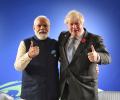
Prime Minister Narendra Modi on Monday met his British counterpart Boris Johnson on the sidelines of the COP26 climate summit here and discussed ways to enhance bilateral cooperation in areas like green hydrogen, renewables and clean technology, economy and defence.

A delegation of high-level executives from US public pension funds (non-profit and government sectors) is visiting India next week to assess and familiarise themselves with the investment opportunities in the country. These executives belong to various American states and cumulatively represent $1.8 trillion in assets under management (AUM) invested across the US and global markets. The United States (US) mission to India, which includes its embassy and consulates and the Department of Treasury, along with India's Ministry of Finance and the National Investment and Infrastructure Fund (NIIF), is hosting the delegation.

'A long-term investor with a 4 to 5 year horizon could invest in this theme via SIPs.'

India's merchandise exports rose by 9.1 per cent to $38.13 billion in May even as the trade deficit widened to a seven-month high of $23.78 billion during the month, according to government data. Healthy growth in sectors, such as engineering, electronics, pharmaceuticals, textiles and plastics helped register growth in exports despite global economic uncertainties.

On the Ukraine conflict, Modi said, "Some people say that we are neutral. But we are not neutral. We are on the side of peace." "All countries should respect international law and the sovereignty of countries," he said.

Prime Minister Narendra Modi on Friday held bilateral talks with Italian counterpart Giorgia Meloni in Bari during which they discussed defence and security cooperation and hoped for further enhancing the defence industrial collaboration.
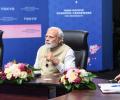
As US President Joe Biden launched a new trade deal with 12 Indo-Pacific nations, including India, to enhance trade, economic and investment opportunities, China, which sees the pact as a threat to its dominance in the region, went on the offensive against it, promising more opening up, while the official media here termed it as "economic Nato".

'The private sector believes that some enablers in labour-intensive sectors like apparel, toys, tourism, and media retail, can unlock a lot of jobs.'

'At the heart of the strategic relationship between our countries are economic ties.'

In a post on X, Modi said, "Happy to have welcomed @POTUS @JoeBiden to 7, Lok Kalyan Marg. Our meeting was very productive."
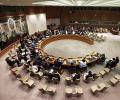
"In India's development cooperation, we will be guided by our partners' development priorities. Our assistance does not create indebtedness and is without conditionalities," he said at the 44th Annual Meeting of the G-77 Foreign Ministers on Thursday, in a veiled reference to China's loans which has led to debt-traps in some countries.

The prime minister in his intervention at the session on "global economy and global health" also flagged the issue of facilitating international travel and talked about the mechanism of mutual recognition of vaccine certification as a means of achieving this, according to the text of his intervention shared by his office.

The delegation visiting India during September 5-8 will be led by assistant secretary of state for South and Central Asian affairs Donald Lu.

India must be prepared to deal with climate disasters, geopolitical confrontations, and social strife linked to global events, asserts Jayant Sinha, chairman of Parliament's Standing Committee on Finance.

Unprecedented bribery charges, farewells, separation, failed union, monumental mergers and record-breaking IPOs, along with a healthy dose of online happenings in the form of spat and lessons in customer care, corporate India saw it all in 2024.
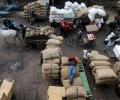
India is likely to grow by 7.5 per cent in the first quarter of the current financial year, driven by rising aggregate demand and non-food spending in the rural economy, according to an article in the RBI's May Bulletin released on Tuesday. The Indian economy has demonstrated marked resilience in the face of geopolitical headwinds impacting the supply chain, said an article on the state of the economy published in the May Bulletin.

End users should take the plunge despite higher home loan rates as these tend to be cyclical.
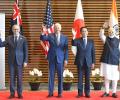
Biden welcomed Prime Minister Modi at the Summit and said "it is wonderful to see you again in person".

'We have to plan for whatever the new normal is.'

The prime minister is participating in the G20 Summit in Rome from October 30- 31 at the invitation of Italian Prime Minister Mario Draghi.

India will drive growth in the Asia-Pacific (Apac) region as the growth engine is likely to shift from China to South and Southeast Asia in the coming years, S&P Global Ratings said in a report on Tuesday. The rating agency's report projected China's growth to slow down to 4.6 per cent by 2026 from an estimated 5.4 per cent in 2023. India is likely to clock 7 per cent economic growth from 6.4 per cent estimated for 2023.

The Reserve Bank of India on Wednesday retained its growth projection at 7.2 per cent for the current fiscal on the back of improvement in urban demand and gradual recovery in rural India. Unveiling the third monetary policy for the current fiscal, RBI Governor Shaktikanta Das said the Indian economy remained resilient, and the central bank will continue to support growth. The RBI expects growth in the first quarter of the current fiscal at 16.2 per cent, which will taper to 4 per cent by the fourth quarter.
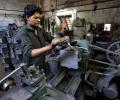
India's manufacturing sector activity rose to a 13-month high in December, supported by healthy inflows of new business and strong demand conditions, according to a monthly survey. The seasonally adjusted S&P Global India Manufacturing Purchasing Managers' Index (PMI) stood at 57.8 in December, up from 55.7 in November, as business conditions improved to the greatest extent in over two years. The December PMI data pointed to an improvement in overall operating conditions for the 18th straight month.

The Tata group on Thursday launched its super app, Tata Neu, bringing all its brands in one platform as it seeks to play a major role in the Indian ecommerce space currently dominated by the likes of Amazon and Flipkart.
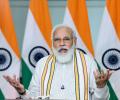
"Prime Minister Narendra Modi will be participating, along with Prime Minister of Australia Scott Morrison and Prime Minister of Japan Yoshihide Suga and President of USA Joseph R. Biden, in the first Leaders' Summit of the Quadrilateral Framework, being held virtually on March 12," the MEA said in a statement.
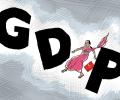
Indian economy is projected to grow 7.1-7.6 per cent in the current financial year despite shifting geopolitical realities across the world, a report said on Wednesday. In its India's economic outlook - July 2022 report, leading consultancy Deloitte India said that as 2021 was coming to a close, there was optimism in the air but the optimism received a jolt early this year as a wave of Omicron infections swept through the country and Russia's invasion of Ukraine happened in February. "These events aggravated the pre-existing challenges such as surging inflation, supply shortages, and shifting geopolitical realities across the world with no definite end in sight.

Companies are trying to absorb the rising costs by investing in consistent supplies. One of the biggest priorities is to make the supply chain more efficient and resilient.

Passenger vehicle dispatches from factories to dealers declined 13 per cent to the lowest level in five years in December last year as the industry continued to face production issues due to semiconductor shortage, auto industry body SIAM said on Friday. Passenger vehicle dispatches last month stood at 2,19,421 units compared to 2,52,998 units in December 2020. While acknowledging that the chip shortage situation is not expected to dramatically change in the short term, the industry body expressed hope that things will improve soon.

India's economy could prove to be the "most resilient" in the subregion of South and South-West Asia over the long term, according to a report by the UN, which says a positive but lower economic growth post COVID-19 pandemic and the country's large market will continue to attract investments. The report titled 'Foreign Direct Investment Trends And Outlook In Asia And The Pacific 2020/2021', and compiled by United Nations Economic and Social Commission for Asia and the Pacific (UNESCAP), stated that inward FDI flows to South and South-West Asia slightly decreased by 2 per cent in 2019, from $67 billion in 2018 to $66 billion in 2019. The growth, however, was mainly driven by India, which accounted for 77 per cent of the total inflows to the subregion and received $51 billion in 2019, up 20 per cent from the previous year.

The external affairs minister reiterated India's position on Afghanistan and highlighted its humanitarian support to the war-torn country, including the supply of wheat, medicines, vaccines and clothing.

Reflecting subdued global economic growth, India's outward foreign direct investment (FDI) fell by 33.3 per cent sequentially to $1.21 billion in August, compared to over $1.82 billion in July.
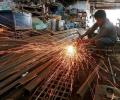
India's manufacturing sector activity moderated in January amid slower increase in total sales, and headcounts were broadly unchanged amid sufficient staff numbers to cope with current requirements, according to a monthly survey. The seasonally adjusted S&P Global India Manufacturing Purchasing Managers' Index (PMI) fell from December's recent high of 57.8 to 55.4 in January, as factory orders and production rose at sharp, albeit slower, rate. The January PMI data pointed to an improvement in overall operating conditions for the 19th straight month.

'Large-caps are better placed to withstand the impact of higher input cost inflation, rising rates and withdrawal of excess global liquidity.'
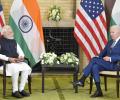
Biden praised India's Covid vaccination efforts.

Most Indian chief executives are optimistic about the economy and believe it would improve in the coming 12 months, said a survey by consulting and auditing firm PwC on Tuesday. The company's 27th annual global survey polled 4,702 chief executive officers (CEOs) in 105 countries and territories, including 79 in India, from October 2 to November 10, 2023. As many as 86 per cent of CEOs in India - 30 per cent higher than a year ago - are confident that the economy would improve.

National Security Council Coordinator for Strategic Communications (NSCCSC) John Kirby on Tuesday told a press conference in Washington, DC: "India will be a critical strategic partner for the United States in the coming decades."

The India-US strategic partnership is characterised by mutual trust and both sides are increasingly in agreement on key issues, such as countering China's aggression, promoting a free and open Indo-Pacific and addressing regional security challenges, Defence Minister Rajnath Singh said on Friday.
